
1 in 6 Chicago Bridges Carry Federal “Poor” Rating
100 of Chicago's 601 bridges carry a 'poor' federal rating, more than double the national average, with the Grand Avenue Bridge flagged as most urgent.
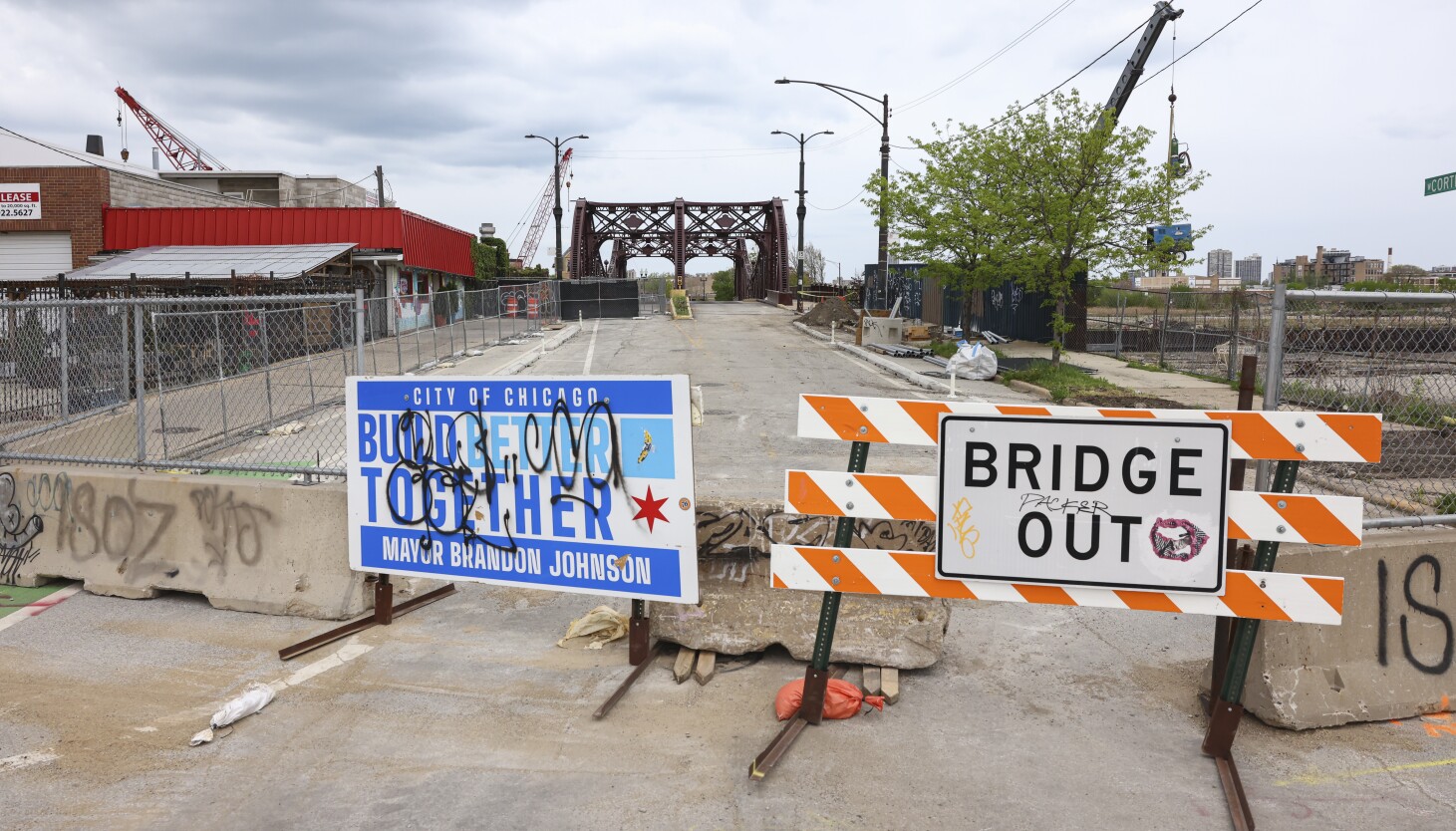
One in six Chicago bridges carries a “poor” condition rating, and engineers warn the Grand Avenue Bridge over the North Branch of the Chicago River could be the next structure forced into emergency closure.
Exactly 100 of the city’s 601 bridges are rated “poor” by federal inspectors, according to a Chicago Sun-Times analysis of national bridge inventory records. That’s 16.6%, more than double the national average of 6.7%, according to data from the American Society of Civil Engineers.
Farhad Ansari, a University of Illinois Chicago professor of engineering who reviewed inspection records for some of the city’s most heavily used bridges, said the Grand Avenue structure stands out as one of the worst he examined.
“I’d say that’s the most likely bridge they look at in the near future,” Ansari said. “Its superstructure, and basically all the truss work are in critical condition.”
Ansari identified several other bridges as contenders for potential emergency closures, though he singled out Grand Avenue as the most urgent concern.
The findings land as Chicago enters bridge lifting season, when the city raises its historic bascule bridges along the Chicago River to allow recreational boats to pass underneath. That ritual, a familiar sign of spring for longtime residents, now carries a harder edge given what engineers say about the structural condition of the spans doing the lifting.
The city got a taste of what deferred maintenance looks like in practice when it closed five river bridges simultaneously in 2026 to catch up on a backlog of repairs. The move was unusual. It was also punishing for commuters.
Traffic snarls choked the Near North Side for much of that year. The State Street Bridge reopened in March 2026 after nearly a year of emergency repairs, providing some relief to drivers who had been rerouting through surface streets for months. That bridge had shut down unexpectedly in April 2025, several months before engineers had planned to begin work on it.
The simultaneous closures were a direct result of the city letting repair needs accumulate across its bridge inventory, which includes dozens of bascule bridges with movable spans that require more intensive mechanical upkeep than fixed structures. Chicago’s network of movable bridges over the Chicago River is one of the largest concentrations of such structures in the world, and that complexity drives up both maintenance costs and the consequences of neglect.
Federal bridge inspection data, available through the U.S. Department of Transportation, rates bridges on a scale that classifies structures as “good,” “fair,” or “poor” based on the condition of their deck, superstructure, and substructure. A “poor” rating doesn’t mean a bridge is unsafe for immediate use. It means one or more key components has deteriorated to the point where the structure requires close monitoring and prioritized repair. Engineers say the distinction matters, but so does the trend line: deferred maintenance on a “poor” bridge doesn’t produce a “fair” bridge. It produces an emergency closure.
That’s what happened on State Street. Engineers knew the bridge needed work. The timeline slipped. The bridge failed on its own schedule, not the city’s.
For South and West Side neighborhoods, the stakes extend beyond inconvenience. Bridge closures on routes like Grand Avenue don’t just create commuter headaches. They cut off access for freight, buses, and emergency vehicles in areas that already carry heavier traffic loads relative to infrastructure investment.
The city hasn’t announced any scheduled closure for the Grand Avenue Bridge.
Chicago’s bridge inventory includes structures maintained by the city’s Department of Transportation, the Illinois Department of Transportation, and other agencies, which complicates unified oversight. Responsibility for inspection and repair depends on which entity owns a given structure, and the ownership map across 601 bridges is not simple.
What is clear is that 100 bridges carrying a “poor” rating, in a city that spent much of 2025 scrambling to manage the fallout from closing five bridges at once, leaves little room for the kind of slow-roll repair scheduling that created the backlog in the first place. Ansari said the engineering community has been raising alarms about Chicago’s bridge stock for years, and the State Street closure brought those concerns into public view in a way that inspection data alone hadn’t managed.
The bridge lifting season will continue through late spring. The Grand Avenue Bridge, for now, will keep opening too.