
UChicago Grad Students Win $10,000 in Stadium Funding Contest
Three UChicago grad students won $10,000 pitching a disciplined public investment framework for Chicago stadiums at the Harris Policy Innovation Challenge.
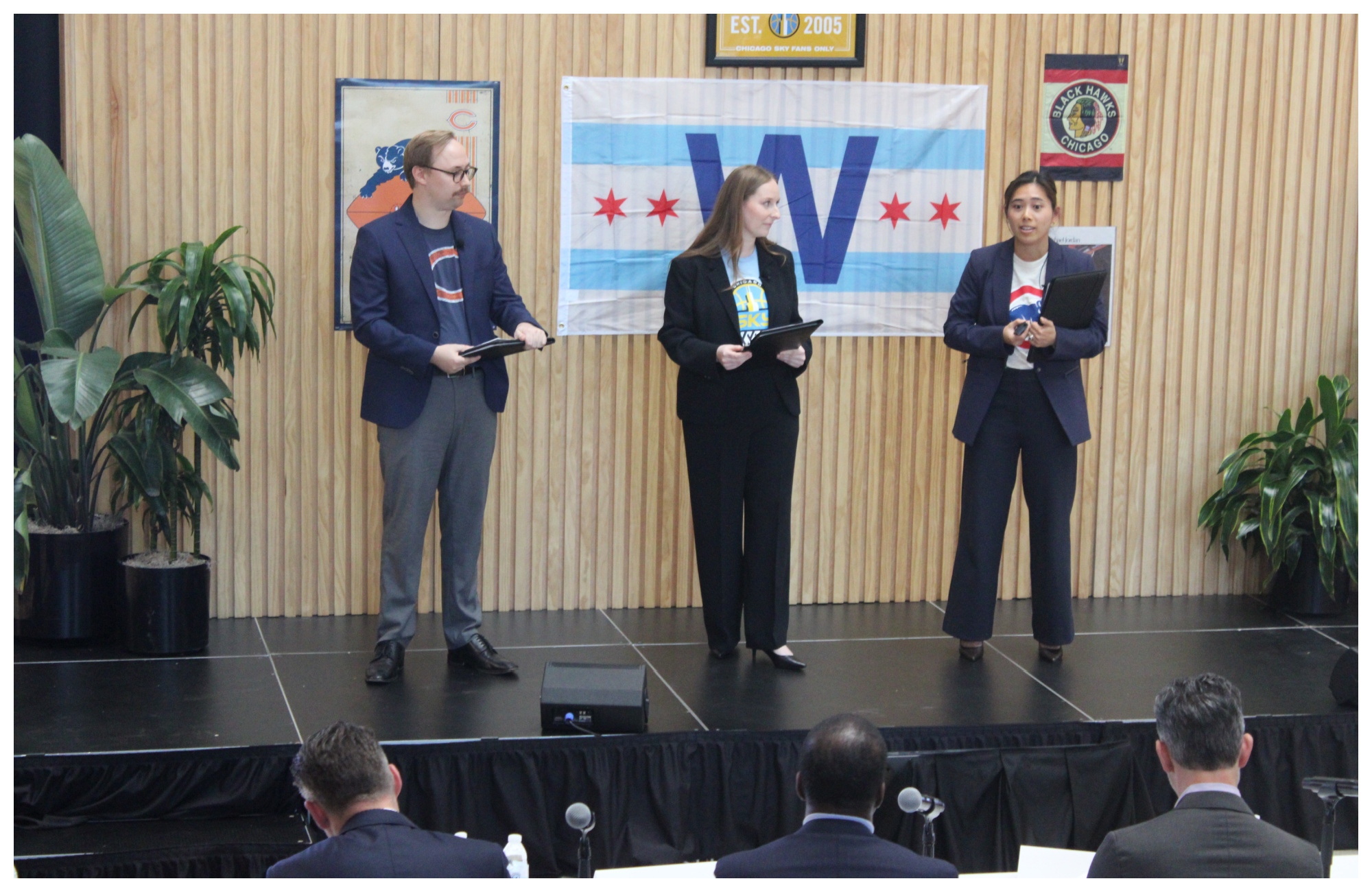
Three University of Chicago graduate students walked away with $10,000 Thursday after pitching a disciplined public investment framework for Chicago stadiums at the Harris Policy Innovation Challenge in Hyde Park.
Christine Tsai, Liz Williams and Charlie Schraw won with a proposal called “Structuring the Deal: A Disciplined Framework for Public Stadium Investment in Chicago,” beating out two competing teams before a panel of judges that included former Netflix CFO David Wells, former Ernst and Young CEO Mike Parker, Nicor Illinois Community Investment Executive Director Tovah McCord and Ald. Bill Conway of the 34th Ward.
The competition, now in its third year at the Harris School of Public Policy, isn’t just a classroom exercise. Teams spend months attending seminars, consulting with policy veterans and industry leaders before presenting their proposals “Shark Tank”-style on stage at Keller Center. This year’s central question was direct: What should be the city of Chicago’s policy toward supporting professional sports teams and facilities?
Tsai, Williams and Schraw built their answer around three pillars. The first was a stadium securitization corporation modeled on Chicago’s own playbook. The city used a sales tax securitization corporation in 2017 to shield the general fund, and the team proposed applying that same structure to stadium financing, issuing bonds backed by dedicated revenue streams rather than putting taxpayer money directly on the line. The second pillar was a community benefits agreement with real teeth. Sports teams would face enforceable requirements to meet labor standards, set aside affordable tickets for residents and put anti-displacement protections in place for neighborhoods near new construction. Third, sustainability standards would be non-negotiable, not a suggestion buried in a press release.
The stakes behind the exercise are real.
Stadium conversations have been grinding through City Hall and Springfield for months, with no shortage of competing interests and opinions about who should bear the cost of keeping professional franchises in Chicago. Graduate students rarely get a formal seat at that table. This competition, covered by Block Club Chicago, gave them one.
The two other teams didn’t lack ambition. One group proposed requiring professional sports teams to sell a minority equity stake to the city through a new Chicago Sports Authority, giving the public a direct ownership interest rather than simply handing over subsidies. The other team proposed eliminating public subsidies altogether unless voters approved them through a referendum, paired with a long-term restructuring of Soldier Field’s ownership structure. Both pitches reflected genuine policy tensions the city will have to sort through before any major stadium deal gets done.
The Harris School of Public Policy frames this annual competition as a way to develop practical policy skills. Last year’s cohort tackled downtown revitalization, examining what Chicago could do over the next three years to build a healthy commercial core for the next two decades. This year’s stadium-focused challenge follows the same format but lands in arguably hotter political territory, given the ongoing Bears stadium negotiations and persistent questions about the city’s long-term relationship with its professional sports franchises.
What Tsai, Williams and Schraw emphasized, according to their proposal, is that the city doesn’t have to choose between supporting teams and protecting residents. Their securitization approach, if built correctly, keeps stadium debt from touching the general fund that pays for schools, transit and city services. The community benefits agreement and sustainability standards would require actual enforcement mechanisms rather than handshake deals. The City of Chicago’s budget office and aldermanic oversight would presumably play a role in any such structure, though the students’ proposal didn’t bind itself to any specific legislative vehicle.
None of the three teams spoke Thursday night as if these were abstract hypotheticals. Chicago’s stadium policy debate has real consequences for neighborhoods near Soldier Field on the Near South Side, for residents around any future Bears site, and for a city that has a complicated history with handing out economic incentives to wealthy franchise owners while public infrastructure erodes. The Harris challenge put that complexity on a stage and asked students to work through it rigorously, in public, with judges who have run major corporations and held elected office.
Tsai, Williams and Schraw made a strong enough case to take the $10,000 prize. Whether anyone at City Hall or in Springfield pays attention to a grad student competition is a separate question, but the framework they outlined reflects the kind of structured, condition-heavy approach that municipal finance experts have long argued Chicago needs before signing off on the next major sports facility deal.